Lab Aircraft tools: WIRELESS RECON PROCESS
Steps To Performing A Wireless Penetration Test
- Step 1: Wireless Reconnaissance
- Step 2: Identify Wireless Networks
- Step 3: Vulnerability Research
- Step 4: Exploitation
- Step 5: Reporting
- Step 6: Remediation & Security Controls
STEP 1: 2.4 GHZ WIFI RECON
-
This Wi-Fi protocol protects the access point by utilizing encryption and uses EAPOL authentication.
-
Let’s start with basic wifi spectrum scanning using iwlist in Linux:
- Description
- Iwlist is used to display some additional information from a wireless network interface that is not displayed by iwconfig.
- The main argument is used to select a category of information, iwlist displays in detailed form all information related to this category, including information already shown by iwconfig.
-
iwlist [interface] scanning
-
iwlist [interface] frequency
-
iwlist [interface] rate
-
iwlist [interface] keys
-
iwlist [interface] power
-
iwlist [interface] txpower
-
iwlist [interface] retry
-
iwlist [interface] event
-
iwlist [interface] auth
-
iwlist [interface] wpakeys
-
iwlist [interface] genie
-
iwlist [interface] modulation
-
iwlist —help
-
iwlist —version
AIRCRACK SUITE OF TOOLS
Aircrack-ng is a complete suite of tools to assess WiFi network security.
- It focuses on different areas of WiFi security:
- Monitoring: Packet capture and export of data to text files for further processing by third party tools
- Attacking: Replay attacks, deauthentication, fake access points and others via packet injection
- Testing: Checking WiFi cards and driver capabilities (capture and injection)
- Cracking: WEP and WPA PSK (WPA 1 and 2)
All tools are command line which allows for heavy scripting. A lot of GUIs have taken advantage of this feature.
It works primarily Linux but also Windows, OS X, FreeBSD, OpenBSD, NetBSD, as well as Solaris and even eComStation 2. https://www.aircrack-ng.org/
HTTPS://AIRCRACK-NG.ORG/DOKU.PHP
Documentation
Aircrack-ng suite
- airbase-ng
- aircrack-ng
- airdecap-ng
- airdecloak-ng
- airdriver-ng- REMOVED in 1.2 rc 1
- airdrop-ng
- aireplay-ng
- airgraph-ng
- airmon-ng
- airodump-ng
- airolib-ng
- airserv-ng
- airtun-ng
- besside-ng
- dcrack
- easside-ng
- packetforge-ng
- tkiptun-ng
- wesside-ng
Links to Key Resources
URLS
- Wiki: www.aircrack-ng.org/doku.php
- Patches: patches aircrack-ng.org
- Videos (tutorials): videos.aircrack-ng.org
- Download: download.aircrack-ng.org
- Forum: forum.aircrack-ng.org
- GitHub: https://github.com/aircrack-ng/aircrack-ng/issues
- Photos and videos (events): photos.aircrack-ng.org
- Blog: blog.aircrack-ng.org
- Nightly tarballs: nightly.aircrack-ng.org
- Archive: archive.aircrack-ng.org
- Storage: storage.aircrack-ng.org
- Twitter: twitter.aircrack-ng.org
Lab 1: Tello Hacking, Hijack and Fly Away
Objective: Tello Default Security - so hack it
Lab Objectives
- How do we control or send Tello commands?
- Mobile phone - often the case
- Bluetooth remote control
- More advanced command and control
- Assessment Methodology
- Recon
- Attack prep
- Hacking Tello
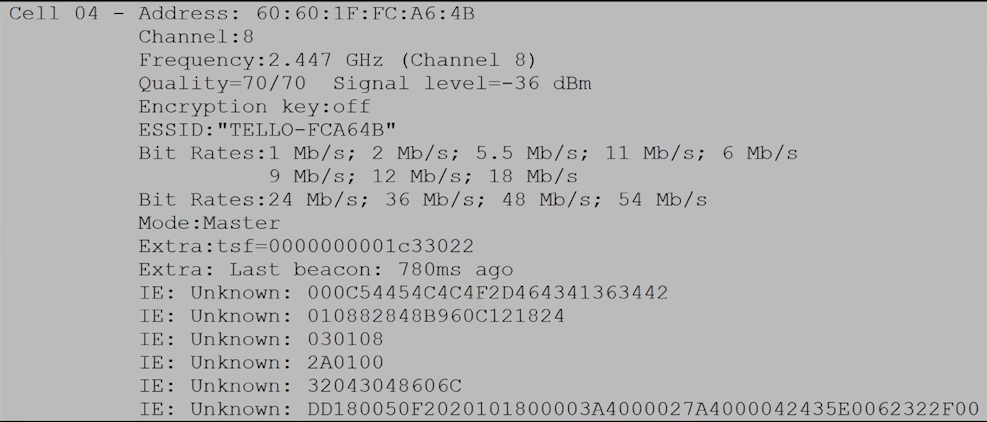
Recon results: AP MAC and Station MAC Address
The results from the Recon Phase (iwlist) noted that NO encryption is used on the Tello by default.
- Our attack will be to kick the remote operator off and have us connect and take over control.
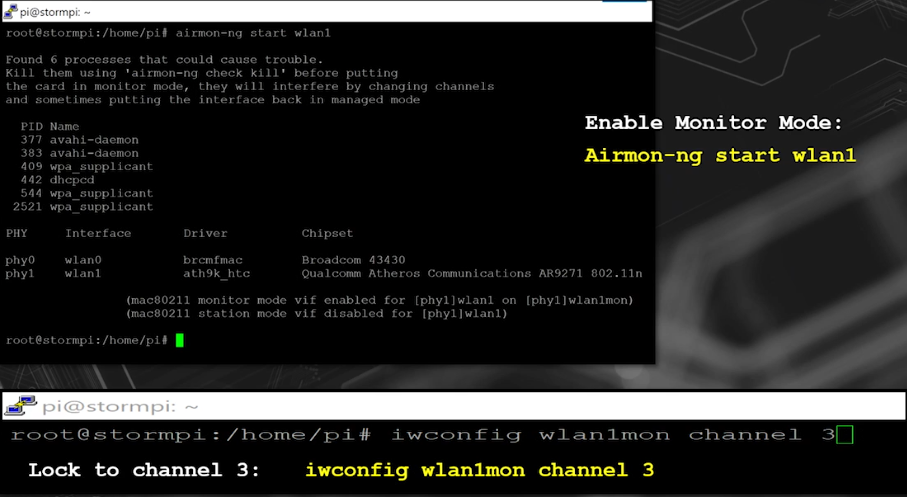
Next: Monitor and lock to the exact wifi channel
Enable Monitor Mode: Airmon-ng start wlanl Lock to channel 3: iwconfig wlanlmon channel 3
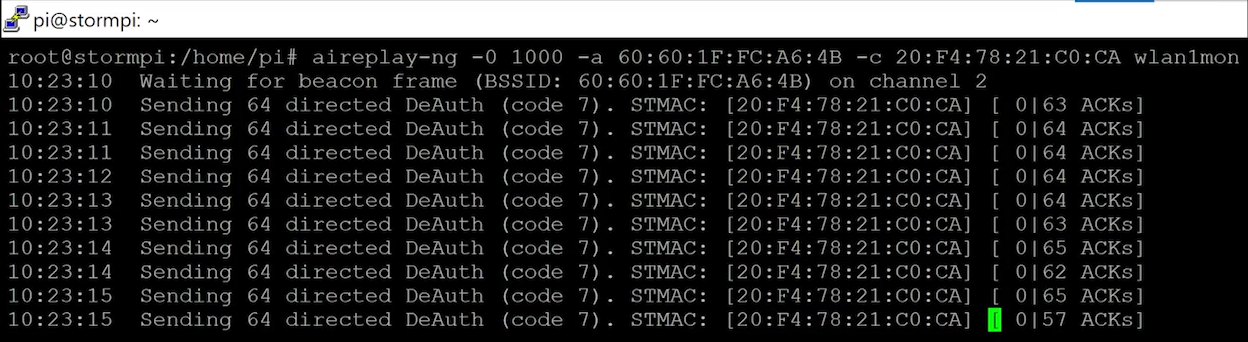
Perform a deauthentication attack against the AP MAC and Station MAC Address
This will allow the hacker to connect to your Tello and fly away.
Partial Countermeasure
Add a password for the Tello AP in the Tello application.
- Remediating the problem will only stop the hacker from taking control until they crack the key.
- Which means, don’t fly over water or too high up if you loose control because a hacker can still deauthenticate your drone and Tello crashes down or forces a landing.
